
The History of the United States: From Prehistory to Modern Times
The history of the United States is a sprawling narrative of exploration, conflict, innovation, and transformation. From the earliest indigenous civilizations to the rise of a global superpower, America’s story reflects the dynamism and contradictions of human history. It is a tale of migration and conquest, liberty and oppression, wealth and inequality, war and peace. The American experiment—rooted in the promise of democratic self-governance—has been tested by slavery, civil war, economic upheaval, and global conflict. Yet, through the triumphs and setbacks, the United States has emerged as a complex and evolving society, shaped by its past and continually redefining its future.
I. Prehistory and Indigenous America (Before 1492)
Long before European explorers set foot on the American continent, indigenous peoples had established complex and sophisticated civilizations across North America. Archaeological evidence suggests that the first human inhabitants of the Americas arrived over 15,000 years ago via a land bridge across the Bering Strait. The early Paleo-Indians adapted to the harsh climate, hunting mammoths and bison with distinctive spear points.
By the time of European contact, indigenous cultures had flourished across the continent. The Ancestral Puebloans of the Southwest constructed elaborate cliff dwellings and irrigation systems, while the Mississippian culture built vast mound complexes at Cahokia, near present-day St. Louis. The Iroquois Confederacy in the Northeast established sophisticated political systems that influenced early American democratic ideas. The indigenous societies of North America were diverse in language, culture, and social organization, reflecting the varied geography and climate of the continent.
The Americas were not a “New World” to the people who inhabited them for millennia. These societies had established trade networks, agricultural practices, and spiritual systems that reflected their deep connection to the land. The arrival of Europeans in the 15th century would disrupt and devastate these indigenous civilizations through disease, violence, and forced displacement.
II. The Colonial Period (1492–1763)
European exploration of the Americas began with Christopher Columbus’s voyage in 1492, sponsored by the Spanish Crown. Over the next century, Spain, France, and England established colonies in North America. The Spanish focused on the Southwest and Florida, founding settlements such as St. Augustine in 1565. The French established trading posts along the St. Lawrence River and the Great Lakes, while the English created permanent settlements along the Atlantic coast.
The first permanent English colony, Jamestown, was founded in 1607 in Virginia. The colony survived thanks to the cultivation of tobacco, which became a highly profitable cash crop. In 1620, the Pilgrims landed at Plymouth and established the Massachusetts Bay Colony. Religious motivations drove much of the English settlement, particularly among the Puritans, who sought to create a “city upon a hill.”
By the early 18th century, the British colonies were thriving economic and social entities. The Atlantic slave trade brought thousands of African slaves to the American colonies, particularly to the southern plantations, where tobacco, rice, and cotton became the economic foundation of the region. Tensions between the colonies and the British Crown over taxation and governance began to grow in the mid-18th century, setting the stage for conflict.
III. The Revolutionary Period (1763–1783)
The seeds of revolution were planted in the aftermath of the French and Indian War (1754–1763), which left Britain with a massive war debt. In an attempt to raise revenue, the British Parliament imposed new taxes on the colonies, including the Stamp Act (1765) and the Townshend Acts (1767). The colonial response was swift and fierce. Protests, boycotts, and violent confrontations—such as the Boston Massacre (1770) and the Boston Tea Party (1773)—galvanized resistance to British rule.
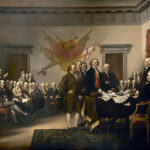
In 1775, armed conflict broke out at Lexington and Concord. The following year, the Second Continental Congress adopted the Declaration of Independence, drafted primarily by Thomas Jefferson, which proclaimed the colonies’ right to self-governance and equality. After years of struggle, American forces under George Washington secured victory over the British at Yorktown in 1781. The Treaty of Paris (1783) formally ended the war, granting the United States independence and territory from the Atlantic to the Mississippi River.
IV. The Confederation and Constitutional Period (1783–1789)
Following independence, the new nation was governed under the Articles of Confederation—a loose framework that granted most powers to the individual states. The national government lacked authority to levy taxes, regulate trade, or maintain a standing army. The weakness of the Confederation became apparent during Shays’ Rebellion (1786–1787), when armed farmers in Massachusetts protested economic hardship and debt.
In response, delegates met in Philadelphia in 1787 to draft a new constitution. The Constitution of the United States, ratified in 1789, created a federal system with a strong executive, a bicameral legislature, and an independent judiciary. The Bill of Rights (1791) guaranteed individual liberties and limited government power. The new constitutional order provided the framework for the modern American state.
V. The Early Republic (1789–1828)
The early years of the republic were marked by political experimentation and ideological conflict. George Washington established the precedent of a peaceful transfer of power, while Alexander Hamilton’s financial program laid the foundation for national economic growth. The rise of political factions, led by Thomas Jefferson’s Democratic-Republicans and Hamilton’s Federalists, reflected competing visions for the nation’s future.
The War of 1812 (1812–1815) against Britain reinforced American nationalism and secured the nation’s independence. The postwar era, known as the Era of Good Feelings (1815–1824), saw the expansion of American territory and the decline of political factionalism.
VI. The Jacksonian Era (1828–1848)
Andrew Jackson’s election in 1828 ushered in an era of mass democracy and political populism. Jackson expanded executive power, challenged the Bank of the United States, and enacted the Indian Removal Act (1830), which forced Native American tribes westward along the Trail of Tears. Jackson’s presidency reflected the growing tension between federal authority and states’ rights, a conflict that would intensify over the issue of slavery.
VII. The Period of Compromise (1849–1858)
The expansion of U.S. territory after the Mexican-American War (1846–1848) reignited the contentious issue of slavery. The Compromise of 1850 admitted California as a free state and imposed a strict Fugitive Slave Act. The Kansas-Nebraska Act (1854), which allowed settlers to determine the status of slavery through popular sovereignty, led to violent conflict in “Bleeding Kansas.”
VIII. The Civil War Period (1861–1865)
The conflict over slavery reached a breaking point in 1860, when Abraham Lincoln’s election prompted Southern states to secede from the Union. The Civil War began with the attack on Fort Sumter in April 1861. After four years of brutal conflict, the Union emerged victorious. Lincoln’s Emancipation Proclamation (1863) and the 13th Amendment (1865) ended slavery, but the war left deep scars on the nation.
IX. Reconstruction (1865–1877)
Reconstruction sought to reintegrate the Southern states into the Union and protect the rights of freed African Americans. The 14th and 15th Amendments guaranteed citizenship and voting rights to African Americans, but white supremacist violence and the rise of Jim Crow laws in the South undermined these gains.
X. The Gilded Age (1877–1900)
The rise of industrial capitalism produced rapid economic growth but also massive inequality. Figures like John D. Rockefeller and Andrew Carnegie amassed enormous wealth, while laborers struggled for fair wages and conditions. Political corruption, monopolies, and urbanization defined the era.
XI. The Progressive Era and World War I (1900–1920)
The Progressive Era emerged as a response to the social and economic challenges of the Gilded Age. Industrialization, urbanization, and corporate monopolies had created unprecedented wealth for some but crushing poverty and harsh working conditions for others. The rise of muckraking journalists like Ida Tarbell, Lincoln Steffens, and Upton Sinclair exposed the corruption of political machines, the exploitation of workers, and the health hazards of unregulated industries. Sinclair’s novel The Jungle (1906) shocked the public with its description of unsanitary meatpacking practices and led directly to the passage of the Pure Food and Drug Act (1906) and the Meat Inspection Act (1906).
Progressive reformers sought to curb the power of big business through antitrust legislation and greater government oversight. President Theodore Roosevelt became the face of progressivism, using the Sherman Antitrust Act to break up monopolies like Standard Oil and Northern Securities. Roosevelt also championed labor rights, supported the conservation movement, and established national parks to protect the country’s natural resources. His successor, William Howard Taft, continued the antitrust crusade but alienated progressives with his more conservative stance on tariffs and business regulation.
The Progressive Era reached its political peak under Woodrow Wilson (1913–1921). Wilson’s New Freedom platform included the establishment of the Federal Reserve System (1913) to regulate the banking sector and the passage of the Clayton Antitrust Act (1914) to strengthen competition laws. Wilson also oversaw the passage of the 19th Amendment (1920), granting women the right to vote—a culmination of the decades-long struggle by the suffrage movement led by figures like Susan B. Anthony and Elizabeth Cady Stanton.
The United States entered World War I in 1917 after repeated German attacks on American ships and the interception of the Zimmerman Telegram, which revealed German attempts to form an alliance with Mexico. Wilson framed the war as a fight for democracy, declaring that America’s involvement would “make the world safe for democracy.” The war effort mobilized the American economy and workforce, but it also led to increased government control over industry and civil liberties. The Espionage Act (1917) and the Sedition Act (1918) criminalized dissent, and thousands of suspected radicals were arrested during the Palmer Raids (1919–1920).
Wilson’s vision for a postwar order centered on the creation of the League of Nations, but the U.S. Senate rejected the Treaty of Versailles, reflecting a growing isolationist sentiment in the country. The failure of the League of Nations weakened Wilson politically and set the stage for future global conflicts.
XII. The Roaring Twenties and the Great Depression (1920–1939)
The 1920s were marked by economic prosperity, social change, and cultural dynamism. The rise of mass production techniques, pioneered by Henry Ford, made automobiles, radios, and household appliances more affordable to the average American. The consumer economy flourished, fueled by easy credit and stock market speculation.
The period was also one of significant social change. The 1920s saw the rise of the Harlem Renaissance, an explosion of African American cultural expression in literature, music, and the arts. Figures like Langston Hughes, Zora Neale Hurston, and Louis Armstrong shaped American culture with their contributions to jazz and literature. However, the 1920s also saw a resurgence of nativism and racial intolerance. The Ku Klux Klan reached its peak membership, and the Immigration Act of 1924 severely restricted immigration from Eastern and Southern Europe.
The prosperity of the Roaring Twenties ended abruptly with the stock market crash of October 1929. Over the next three years, the Great Depression devastated the American economy. Banks collapsed, businesses closed, and unemployment soared to 25%. President Herbert Hoover attempted to stabilize the economy through voluntary business cooperation and limited public works programs, but his efforts failed to reverse the collapse.
The election of Franklin D. Roosevelt in 1932 ushered in a new era of government intervention. Roosevelt’s New Deal sought to stabilize the economy through a series of federal programs, including the Civilian Conservation Corps (CCC), the Works Progress Administration (WPA), and the Social Security Act (1935). The New Deal expanded the role of the federal government and established a social safety net that endures to this day.
XIII. World War II and the Rise of American Power (1939–1945)
The outbreak of World War II in 1939 initially saw the United States adopt a policy of neutrality. However, the Japanese attack on Pearl Harbor on December 7, 1941, propelled the nation into the conflict. American industry mobilized for war, transforming the economy and creating new opportunities for women and minorities. The military success of the D-Day invasion (1944) and the capture of Berlin in 1945 secured Allied victory in Europe. In the Pacific, the atomic bombings of Hiroshima and Nagasaki in August 1945 forced Japan to surrender.
World War II elevated the United States to global superpower status. The establishment of the United Nations and the Marshall Plan reflected America’s new leadership role in world affairs.
XIV. The Cold War (1945–1959)
The postwar era was dominated by the geopolitical rivalry between the United States and the Soviet Union. The Cold War shaped American foreign and domestic policy as both superpowers competed for influence around the globe. The Truman Doctrine (1947) and the Marshall Plan sought to contain the spread of communism in Europe, while the formation of NATO (1949) created a military alliance against Soviet aggression.
The Korean War (1950–1953) marked the first major military conflict of the Cold War. Domestically, the rise of McCarthyism reflected fears of communist infiltration, as Senator Joseph McCarthy led a campaign to identify and purge suspected communists from government and society.
XV. The 1960s and 1970s (1960–1979)
The 1960s began with the election of John F. Kennedy, whose administration championed civil rights and the space race. Kennedy’s assassination in 1963 shocked the nation. Under Lyndon B. Johnson, landmark civil rights legislation—the Civil Rights Act (1964) and the Voting Rights Act (1965)—outlawed racial discrimination.
The Vietnam War dominated the late 1960s and early 1970s. Opposition to the war fueled social unrest, leading to mass protests and the rise of the counterculture. Richard Nixon’s presidency saw the expansion of U.S. involvement in Vietnam and the eventual withdrawal of troops in 1973. The Watergate scandal led to Nixon’s resignation in 1974.
XVI. The Reagan Era (1980–1992)
The Reagan Era (1980–1992): The Triumph of Conservatism and the End of the Cold War
The election of Ronald Reagan in 1980 ushered in a profound shift in American politics, economics, and global strategy. Reagan’s presidency represented a decisive break from the liberal consensus that had dominated American government since Franklin D. Roosevelt’s New Deal. The Reagan era marked the rise of modern conservatism, defined by tax cuts, deregulation, a renewed emphasis on military strength, and a commitment to reducing the role of the federal government in the economy. Reagan’s unapologetically pro-market and anti-communist policies helped reshape the trajectory of American domestic and foreign policy and played a pivotal role in bringing the Cold War to a close.
I. The 1980 Election and the Rise of the New Right
Reagan’s victory in the 1980 presidential election was fueled by a convergence of economic distress, national insecurity, and cultural conservatism. The 1970s had been marked by stagflation—a combination of high inflation, unemployment, and sluggish economic growth—along with a series of geopolitical setbacks, including the Iran hostage crisis and the perceived decline of American global influence following the Vietnam War.
Reagan ran on a platform of restoring “peace through strength” and reviving the American economy through tax cuts, deregulation, and a smaller federal government. He was backed by a powerful coalition of social conservatives, free-market economists, and defense hawks—groups that became known as the New Right. Reagan’s ability to unite economic libertarians, religious conservatives, and foreign policy hardliners created a durable conservative political base that would shape American politics for decades.
Reagan defeated incumbent Democrat Jimmy Carter in a landslide, winning 44 states and securing 489 electoral votes to Carter’s 49. His victory signaled a dramatic shift in the political landscape, ending the dominance of New Deal liberalism and ushering in an era of conservative ascendancy.
II. Reaganomics: Supply-Side Economics and Tax Cuts
One of Reagan’s central domestic policies was his economic agenda, popularly known as Reaganomics. Influenced by the theories of economist Arthur Laffer, Reaganomics was rooted in the principles of supply-side economics—the idea that cutting taxes and reducing government regulation would stimulate investment, increase productivity, and create economic growth.
Tax Cuts
Reagan’s first major legislative victory came with the passage of the Economic Recovery Tax Act (ERTA) in 1981, which slashed the top individual income tax rate from 70% to 50% and cut the corporate tax rate. Subsequent tax reforms further reduced rates, and by the end of his presidency, the top individual tax rate had been lowered to 28%—the lowest level since the 1920s.
Deregulation
Reagan also pushed for widespread deregulation of industries, arguing that government interference stifled innovation and economic growth. His administration rolled back regulations on banking, airlines, telecommunications, and energy markets. Reagan also dismantled parts of the New Deal-era regulatory state, including weakening the power of labor unions through measures like firing over 11,000 air traffic controllers who had gone on strike in 1981.
Government Spending and Deficits
Despite his commitment to smaller government, Reagan presided over a dramatic increase in federal spending—particularly on defense. While domestic programs were cut, military spending soared, contributing to rising budget deficits. By the end of Reagan’s presidency, the national debt had tripled from $900 billion to $2.7 trillion.
The immediate economic effects of Reaganomics were mixed. The early years of Reagan’s presidency were marked by a severe recession, with unemployment peaking at 10.8% in 1982. However, the economy rebounded sharply in 1983, and by 1984 the United States entered a period of sustained growth. The stock market surged, inflation fell, and millions of jobs were created. Reagan’s supporters credited his tax and regulatory policies with restoring economic confidence, while critics argued that the benefits of the recovery were disproportionately concentrated among the wealthy.
III. Foreign Policy and the Cold War
Reagan’s foreign policy was driven by a desire to confront and roll back Soviet influence around the globe. His administration rejected the doctrine of containment that had guided U.S. policy during the Cold War and instead pursued a more aggressive strategy aimed at undermining communist regimes and expanding American military strength.
Military Buildup
Reagan presided over the largest peacetime military buildup in American history. Defense spending increased by over 40% during his presidency, funding new weapons systems such as the MX missile, the B-1 bomber, and the Strategic Defense Initiative (SDI)—a missile defense system designed to protect the United States from nuclear attack. Critics dubbed SDI “Star Wars” and argued that it was technologically unfeasible, but it sent a clear signal to Moscow that the U.S. was prepared to challenge Soviet military superiority.
The Reagan Doctrine
Reagan’s strategy of confronting communism extended beyond the military buildup. The Reagan Doctrine provided financial and military support to anti-communist insurgencies and governments around the world. This included aid to the Mujahideen in Afghanistan, support for the Contras fighting the leftist Sandinista government in Nicaragua, and backing for anti-communist movements in Angola and Cambodia.
Engagement with the Soviet Union
In his early years, Reagan’s rhetoric toward the Soviet Union was uncompromising. In 1983, he famously described the Soviet Union as an “evil empire.” However, the rise of Mikhail Gorbachev as Soviet leader in 1985 opened the door for diplomatic engagement.
Reagan and Gorbachev met at a series of summits that culminated in the signing of the Intermediate-Range Nuclear Forces (INF) Treaty in 1987, which eliminated an entire class of nuclear weapons. Reagan’s willingness to combine military strength with diplomatic outreach played a key role in the eventual dissolution of the Soviet Union.
IV. The Culture Wars and Domestic Policy
Reagan’s presidency also shaped American cultural and social policy. He appointed three conservative justices to the Supreme Court, including Sandra Day O’Connor, the first woman to serve on the Court. These appointments shifted the Court to the right on issues like abortion, affirmative action, and criminal justice.
Reagan aligned himself with the rising Christian Right, opposing abortion rights and advocating for prayer in public schools. His administration also took a conservative stance on issues of race and civil rights, cutting funding for social programs and opposing affirmative action measures.
The Reagan administration was criticized for its response to the AIDS epidemic, which emerged in the early 1980s. Reagan initially ignored the crisis, and it was not until the mid-1980s that his administration began to address the epidemic through public health initiatives.
V. The 1984 Election and the Second Term
Reagan’s reelection in 1984 was one of the most decisive in American history. Running on the slogan “Morning in America,” Reagan defeated Democratic challenger Walter Mondale in a landslide, winning 49 out of 50 states.
Reagan’s second term was overshadowed by the Iran-Contra scandal (1986), in which senior administration officials were found to have secretly sold weapons to Iran and diverted the proceeds to fund the Contras in Nicaragua. While Reagan denied knowledge of the operation, the scandal tarnished his reputation and led to multiple investigations.
VI. The End of the Cold War and Reagan’s Legacy
The final years of Reagan’s presidency coincided with the unraveling of the Soviet Union. The fall of the Berlin Wall in 1989 symbolized the collapse of communist regimes in Eastern Europe. In 1991, the Soviet Union formally dissolved, ending the Cold War and marking the triumph of the American-led global order.
Reagan left office in 1989 with high approval ratings. His legacy remains complex and polarizing. Supporters credit Reagan with reviving the American economy, restoring national confidence, and helping to win the Cold War. Critics argue that Reaganomics deepened inequality and that his administration’s foreign policy created long-term instability. Nevertheless, Reagan’s presidency transformed the ideological and political landscape of the United States, setting the stage for the rise of modern conservatism.
XVII. The Clinton Period (1992–2000)
The Clinton Period (1992–2000): Economic Prosperity, Political Scandal, and Globalization
The presidency of Bill Clinton (1993–2001) marked a period of significant economic growth, technological transformation, and political controversy. Clinton, a moderate Democrat from Arkansas, represented a shift toward centrist policies within the Democratic Party. His administration embraced elements of both traditional Democratic priorities, such as healthcare reform and social welfare, and conservative economic policies, including deficit reduction, trade liberalization, and financial deregulation. Clinton’s presidency saw the longest peacetime economic expansion in American history, but it was also marred by political scandal and deep partisan conflict. Clinton’s ability to survive impeachment and leave office with high approval ratings reflected both his political resilience and the profound contradictions of his presidency.
I. The 1992 Election and the Rise of the “New Democrats”
Clinton’s political rise reflected a strategic shift within the Democratic Party. After the party’s losses in the 1980s, Clinton and the Democratic Leadership Council (DLC) sought to reposition the Democrats as a pro-business, fiscally responsible party that embraced globalization and market-based reforms. Clinton campaigned as a “New Democrat,” promising to balance the budget, reduce the deficit, and reform welfare, while also defending traditional Democratic commitments to healthcare, education, and environmental protection.
In the 1992 election, Clinton faced incumbent Republican George H.W. Bush, whose popularity had declined due to a weakening economy and the perception that he was disconnected from domestic concerns. Clinton’s campaign focused on economic issues, summarized in the now-famous slogan, “It’s the economy, stupid.” Clinton also benefited from the candidacy of independent Ross Perot, who siphoned votes from Bush. Clinton won the presidency with 43% of the popular vote and a decisive electoral college victory, carrying 32 states.
II. Economic Growth and the Technology Boom
The defining feature of Clinton’s presidency was the remarkable economic growth that occurred during his two terms. Between 1993 and 2000, the United States experienced its longest period of uninterrupted economic expansion in modern history. Unemployment fell from 7.5% in 1992 to 4.0% by the end of Clinton’s second term—the lowest level in three decades. Inflation remained low, and the federal budget deficit, which had peaked at $290 billion in 1992, turned into a budget surplus by 1998—the first surplus since 1969.
Globalization and Trade Policy
Clinton’s economic success was closely tied to the rise of globalization and the increasing integration of the world economy. One of his most controversial achievements was the negotiation and ratification of the North American Free Trade Agreement (NAFTA) in 1993. NAFTA created a free-trade zone between the United States, Canada, and Mexico, eliminating most tariffs and trade barriers. Proponents argued that NAFTA would boost American exports and create jobs, but critics contended that it encouraged the outsourcing of manufacturing jobs and weakened labor protections.
Clinton also supported American membership in the World Trade Organization (WTO) and pushed for increased trade with China. In 2000, Clinton signed the U.S.–China Relations Act, which normalized trade relations with China and paved the way for China’s entry into the WTO. These policies accelerated the shift toward a globalized economy, increasing American corporate profits and consumer choice but also contributing to growing inequality and the loss of manufacturing jobs.
The Technology Boom
The Clinton years coincided with the rise of the information technology revolution. Advances in personal computing, the growth of the internet, and the rise of e-commerce fueled stock market gains and transformed the American economy. Companies like Microsoft, Apple, Amazon, and Google emerged as dominant forces in the technology sector. The NASDAQ stock index, heavily weighted toward tech companies, rose from 750 in 1995 to over 5,000 in early 2000. The explosion of internet-based businesses created a “dot-com bubble” that would eventually burst in 2001, but during the Clinton years, the tech boom drove stock market gains and increased household wealth.
III. Domestic Policy and Political Conflict
Clinton entered office with ambitious plans for domestic reform, but his early legislative efforts faced intense opposition from Republicans and internal divisions within the Democratic Party.
Healthcare Reform
Clinton’s most ambitious domestic policy initiative was his attempt to reform the American healthcare system. Led by Hillary Clinton, the First Lady, the proposed plan sought to guarantee universal health coverage by creating a government-managed system of employer-based insurance. The plan faced fierce opposition from the insurance industry and Republicans, who argued that it represented government overreach. Despite Democratic majorities in both the House and Senate, the plan failed to pass, and healthcare reform became a political liability for Clinton.
Welfare Reform and Crime Legislation
After the failure of healthcare reform, Clinton shifted toward more conservative domestic policies. In 1996, he signed the Personal Responsibility and Work Opportunity Reconciliation Act, which replaced traditional welfare programs with Temporary Assistance for Needy Families (TANF), imposing time limits and work requirements for recipients. While the legislation reduced welfare rolls, critics argued that it increased poverty and hardship for low-income families.
Clinton also embraced a tough-on-crime agenda. The Violent Crime Control and Law Enforcement Act (1994) increased funding for police, expanded the use of the death penalty, and created mandatory minimum sentences. While crime rates fell during the 1990s, the law contributed to the rise of mass incarceration, particularly among African Americans and other minority groups.
IV. The Monica Lewinsky Scandal and Impeachment
The defining political scandal of Clinton’s presidency emerged from his extramarital affair with Monica Lewinsky, a White House intern. In 1998, independent counsel Kenneth Starr conducted an investigation into Clinton’s relationship with Lewinsky. Clinton initially denied the affair under oath, but later admitted to “inappropriate relations” with Lewinsky.
The scandal escalated into a constitutional crisis when the Republican-controlled House of Representatives voted to impeach Clinton on charges of perjury and obstruction of justice. The impeachment trial in the Senate concluded with Clinton’s acquittal. The charges failed to reach the necessary two-thirds majority for conviction, and Clinton remained in office.
Despite the scandal, Clinton’s approval ratings remained high, buoyed by the strength of the economy and public fatigue with partisan conflict. The impeachment, however, deepened political polarization and damaged Clinton’s credibility on moral issues.
V. Foreign Policy and Global Leadership
Clinton’s foreign policy was shaped by America’s dominance as the world’s only superpower following the collapse of the Soviet Union. Clinton sought to expand American influence through diplomacy, economic aid, and military intervention.
The Balkans and Humanitarian Intervention
Clinton’s most significant foreign policy challenge was the ethnic conflict in the Balkans. In 1995, the U.S. led a NATO bombing campaign that helped bring an end to the Bosnian War, culminating in the Dayton Accords, which established a fragile peace. In 1999, NATO launched airstrikes against Serbia to stop the ethnic cleansing of Albanians in Kosovo.
The Middle East and Terrorism
Clinton also sought to broker peace in the Middle East. He hosted the signing of the Oslo Accords in 1993 between Israeli Prime Minister Yitzhak Rabin and Palestinian leader Yasser Arafat, but the peace process collapsed after Rabin’s assassination in 1995. Clinton also authorized military strikes against Iraq in response to Saddam Hussein’s failure to comply with U.N. weapons inspections.
In 1998, Al-Qaeda bombed U.S. embassies in Kenya and Tanzania, marking the beginning of a wave of terrorist activity that would escalate in the following decade.
VI. Legacy and the 2000 Election
Clinton left office in January 2001 with an approval rating above 60%, despite the impeachment scandal. His presidency was characterized by economic growth, budget surpluses, and political pragmatism. However, the rise of globalization, the growing divide between rich and poor, and unresolved racial and social tensions remained sources of national conflict.
Clinton’s political legacy was reflected in the close and contentious 2000 election between Democrat Al Gore and Republican George W. Bush—an election that would define the beginning of a new era in American politics.
XVIII. The Bush Era (2000–2008)
The terrorist attacks of September 11, 2001 transformed American foreign policy. The Bush administration launched the War on Terror, leading to wars in Afghanistan and Iraq.
XIX. The Obama Era (2009–2016)
Barack Obama’s presidency saw the passage of the Affordable Care Act and the recovery from the Great Recession. The killing of Osama bin Laden in 2011 marked a symbolic victory in the War on Terror.
XX. Modern America (2016–Present)
The election of Donald Trump in 2016 brought deep political polarization. The COVID-19 pandemic, rising racial tensions, and economic challenges continue to shape American society. The presidency of Joe Biden has focused on recovery from the pandemic and global leadership in the face of new geopolitical challenges.